


Article Summary
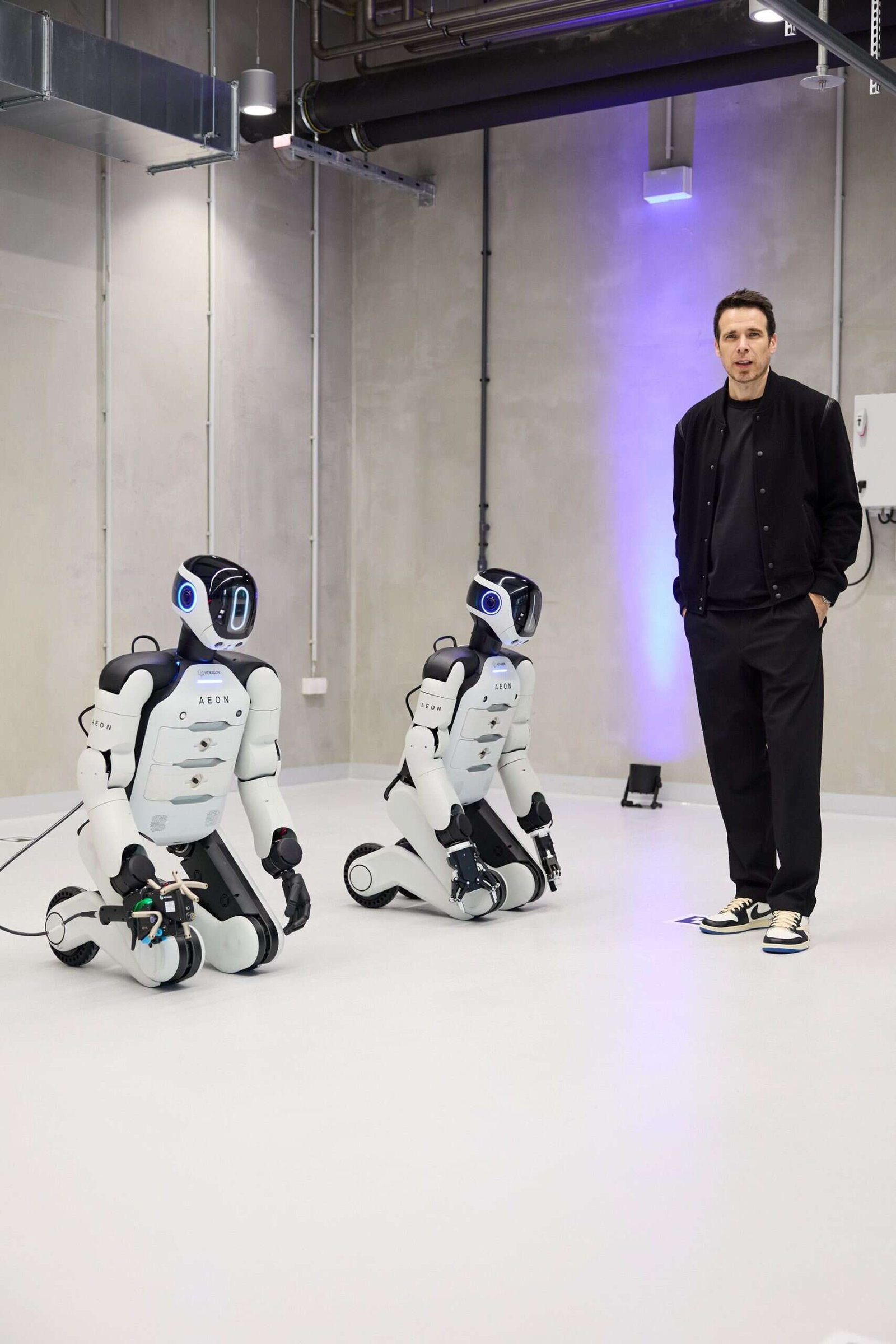
- AEON is BMW’s first humanoid robot in Europe, headed to Plant Leipzig for battery and component manufacturing — with two units targeting full production by end of 2026.
- Hexagon’s AEON uses 22 sensors, self-swapping batteries, and four layers of physical AI including imitation learning — where just 20 demonstrations are enough to train autonomous operation.
- BMW is applying hard lessons from its Spartanburg pilot with Figure AI — 30,000 X3s built, 90,000 parts moved — to accelerate the Leipzig rollout, backed by a new Munich-based Center of Competence for Physical AI.
BMW is placing humanoid robots on the factory floor at its Leipzig plant — the first time the company has deployed them at a European facility — as the auto industry bets on AI-powered robotics to handle physically demanding work and improve production efficiency. The machines, supplied by Hexagon Robotics, will work on assembly lines and in high-voltage battery manufacturing for electric vehicles, an area where employees currently wear cumbersome protective gear and face repetitive physical strain.
The Leipzig pilot began quietly in December 2025. A broader test is planned for April 2026, with a full-scale permanent pilot launching in summer 2026. Two AEON units will work simultaneously across two use cases, with BMW expecting both to be in production by year-end.
“Digitalisation improves the competitiveness of our production — here in Europe and worldwide,” said Milan Nedeljković, BMW’s head of production and incoming CEO. “The symbiosis of engineering expertise and artificial intelligence opens up entirely new possibilities in production.”
Inside the Announcement: BMW’s Talent Campus, Munich

BMWBLOG attended the exclusive reveal event at BMW’s Talent Campus in Munich, where the company brought together media, engineers, and technology partners to unveil the Leipzig partnership and put AEON through its paces in live demonstrations and hands-on workshops. It was a rare look behind the curtain at how BMW is thinking about the next decade of factory work.
Why Leipzig, and Why Hexagon
Leipzig is BMW’s most technologically complete German plant, covering battery manufacturing, component injection molding, press, body shop, and final assembly — meaning testing AEON there covers the full range of production environments in one location.
Hexagon, meanwhile, is a long-standing BMW partner in precision measuring equipment and software. When they moved into physical AI with AEON, BMW already knew their strengths — and it shows. Arnaud Robert, President of Hexagon Robotics, presented the robot at the Talent Campus, making clear that AEON was designed from the ground up for industrial work. “We’re not in the dancing business — we’re in the working business,” he said, drawing a deliberate line between AEON and the performance-focused robots that dominate tech demos.
AEON carries 22 integrated sensors — peripheral cameras, time-of-flight, infrared, SLAM cameras, and microphones — giving it full 360-degree real-time awareness. That sensor suite isn’t just for navigation: it enables quality inspection tasks that traditional fixed robots can’t perform. AEON moves on wheels rather than legs, a choice Robert said came after rigorous testing of multiple locomotion systems. “Wheels turn out to be by far the most efficient locomotion mechanism in terms of energy use and speed over distance,” he explained. “A factory floor is usually super-even surfaces, so we truly benefit from the speed.” AEON reaches 2.5 meters per second and swaps its own battery in 23 seconds, enabling genuine around-the-clock operation.
What AEON Does — and How It Learns

Robert demonstrated two live use cases on stage. First, autonomous door panel inspection: AEON mounted a high-resolution scanner capable of capturing one million points per second at 50-micron resolution, navigated to a car door, and performed a full quality scan — checking assembly tolerances and surface defects — without any human input. Second, a human-robot handoff, demonstrating how AEON adapts when a person enters its workspace mid-task.
AEON learns across four layers of physical AI. At the base: simulation and reinforcement learning, where thousands of virtual instances run simultaneously to discover optimal movement strategies. “It turned out, through simulation and running thousands of potential ways to do this, the most efficient way is actually using inertia,” Robert noted — a result no engineer would have hard-coded.
Above that: perception-based task completion, where telling AEON to “scan the door” is sufficient — it finds the door, positions itself, executes, and reports. Third is imitation learning, where roughly 20 teleoperated demonstrations are enough for AEON to generalize into autonomous operation. BMW’s Competence Center recorded about 2,000 demonstrations for a single bin-picking task, training a model overnight. “If you would automate that with traditional solutions, this would not be a week — this would be a lot more,” a BMW engineer told us during the workshop session. Finally, world models allow AEON to handle unfamiliar objects by reasoning about them in context, adapting grip and movement on the fly.
The Q&A: Candid Answers on Hard Problems

After the demos, Robert fielded a sharp set of questions from the floor — and the exchanges during the workshops were more revealing than the presentation itself.
On LLM hallucination in physical robots, Robert was direct: “We see very, very little hallucination” because AEON’s foundation models are trained on curated, domain-specific factory data rather than the open internet. Two onboard NVIDIA Jetson cards handle all AI processing locally — one for sensor fusion, one for task execution — meaning the robot can detect and correct errors in real time without cloud dependency.
One attendee put the training data challenge bluntly: LLMs like ChatGPT are built on internet-scale data, but “there’s no Google search for robots.” Robert acknowledged it and outlined the two-part answer: continuous teleoperation data collection that feeds back into the model for all robots simultaneously, plus AEON’s sensor advantage — “we capture not only the actuator movements, which most people do, we actually capture the entire data of the environment.” BMW added a third layer: their proprietary manufacturing data — CAD models, digital twins, documented production tasks — is training material no competitor can access.
Asked whether robots could ever keep pace with human workers on BMW’s assembly lines — which run at a takt time of 55–56 seconds per vehicle, with workers physically climbing into moving cars — BMW was frank: “A robot jumping into a moving car and assembling parts — I cannot see this in the near future.” Where robots already have the edge is consistency. “The scanning is a good example,” Robert noted. “The robot learns the optimal way to scan and does it exactly the same way every time. Humans make mistakes and try again.”
On cybersecurity — whether networked robots that learn from each other could be hijacked — Robert acknowledged the concern directly: “We take it pretty seriously, with quite a bit of cybersecurity around it and very little control from the outside.”
Lessons from Spartanburg, Applied in Leipzig

BMW didn’t start this experiment in Europe. The world’s first humanoid deployment at a BMW plant took place in Spartanburg, South Carolina, with Figure AI. Over ten months, Figure 02 worked daily ten-hour shifts on the BMW X3 body shop — moving over 90,000 sheet metal components and logging roughly 1,250 operating hours. “The transition from the lab to real production was, for me, faster than we expected,” said Michael Nikolaides, Senior VP for BMW’s Production Network. Two robots worked in tandem, one operating while the other charged.
The key lesson BMW is applying at Leipzig: involve IT, safety, process management, and logistics from day one. Infrastructure readiness — safety barriers, Wi-Fi 6 connections, standardized interfaces — was a prerequisite, not an afterthought.
A Competence Center and a Long-Term Vision

To scale this work, BMW has established a Center of Competence for Physical AI in Production in Munich. “We deliberately avoid black box models in live production,” Nikolaides explained. Every project is assessed against five criteria: industrial manageability, security, economic viability, integration capability, and scalability.
BMW’s manufacturing data — its CAD models, digital twins, and decades of documented production tasks — gives it a structural training advantage that no external lab can replicate. Asked how many robots BMW might have in five years, Robert didn’t hedge: “I hope there will be thousands — we will see a different world with these robots, also outside manufacturing.” The Leipzig pilot, with two units and two use cases, is where that count begins.

