


Article Summary
- The Neue Klasse replaces BMW’s entire design language — no old-style cars will continue alongside it. The oversized kidney grille era is over, and van Hooydonk has admitted it had drifted too far toward Chinese market tastes at the expense of global appeal.
- The new design brings back proportions from the 1960s originals — vertical kidneys on SUVs, horizontal on sedans, a shark-nose front end, and far cleaner body surfaces — while adding a “phygital” front end that activates as you approach the car.
- The iX3 is already on sale, the i3 debuts this month, and the X5 generation isn’t far behind. Whether you love the new look or not, every BMW going forward will wear it — and for the first time in a while, they’ll all look like they’re part of the same family.
If you’ve been following BMW long enough, you probably remember the moment the giant kidneys stopped feeling bold and started feeling like a problem. It didn’t happen overnight. There was the X7. Then the 4 Series. Then the iX. Each time, BMW pushed harder, and each time, the conversation shifted a little more from the cars themselves to the grilles. That’s not where you want to be as a brand.
The Neue Klasse design language is BMW’s answer to that — and it’s the biggest visual reset since Chris Bangle rewrote the rulebook in the early 2000s. The production 2026 iX3 is the first car wearing it on real roads. The i3 electric sedan debuts March 18. After that, every single BMW gets it. This is worth understanding properly.
A Name That Means Business

BMW didn’t choose “Neue Klasse” by accident. In the 1960s, the original Neue Klasse cars — tight, driver-focused sedans with clean proportions — literally saved the company from going under and became the foundation for everything BMW has been since. The 1602the 2002, the DNA that eventually gave us the E30 and E46. It all traces back to that era.
Calling this new generation Neue Klasse is BMW saying: this is that kind of moment. Not a facelift. Not a platform update. A reset.
Design chief Adrian van Hooydonk hasn’t been shy about it. “Neue Klasse is skipping an entire vehicle generation,” he said. When asked point-blank whether cars in the old design language would continue alongside the new one, he shut it down: “No, we won’t. Neue Klasse is a starting point for a change in our form language,” he told Engine1. Every new BMW from here on looks like this.
The guiding philosophy is electric, digital, circular — but what that actually means for how the cars look is simpler than any of those words. Van Hooydonk described the goal as longevity: “We wanted a formal language that was very long-lasting. That’s why it’s simpler.” He put it even more plainly in another interview for Handelsblatt: “The world is getting louder and louder, so I’m happy if we bring a little peace and quiet.”
For those of us who’ve been waiting for BMW to calm down, that’s a genuinely encouraging thing to hear from the top of the design organization.
The Front End Explained

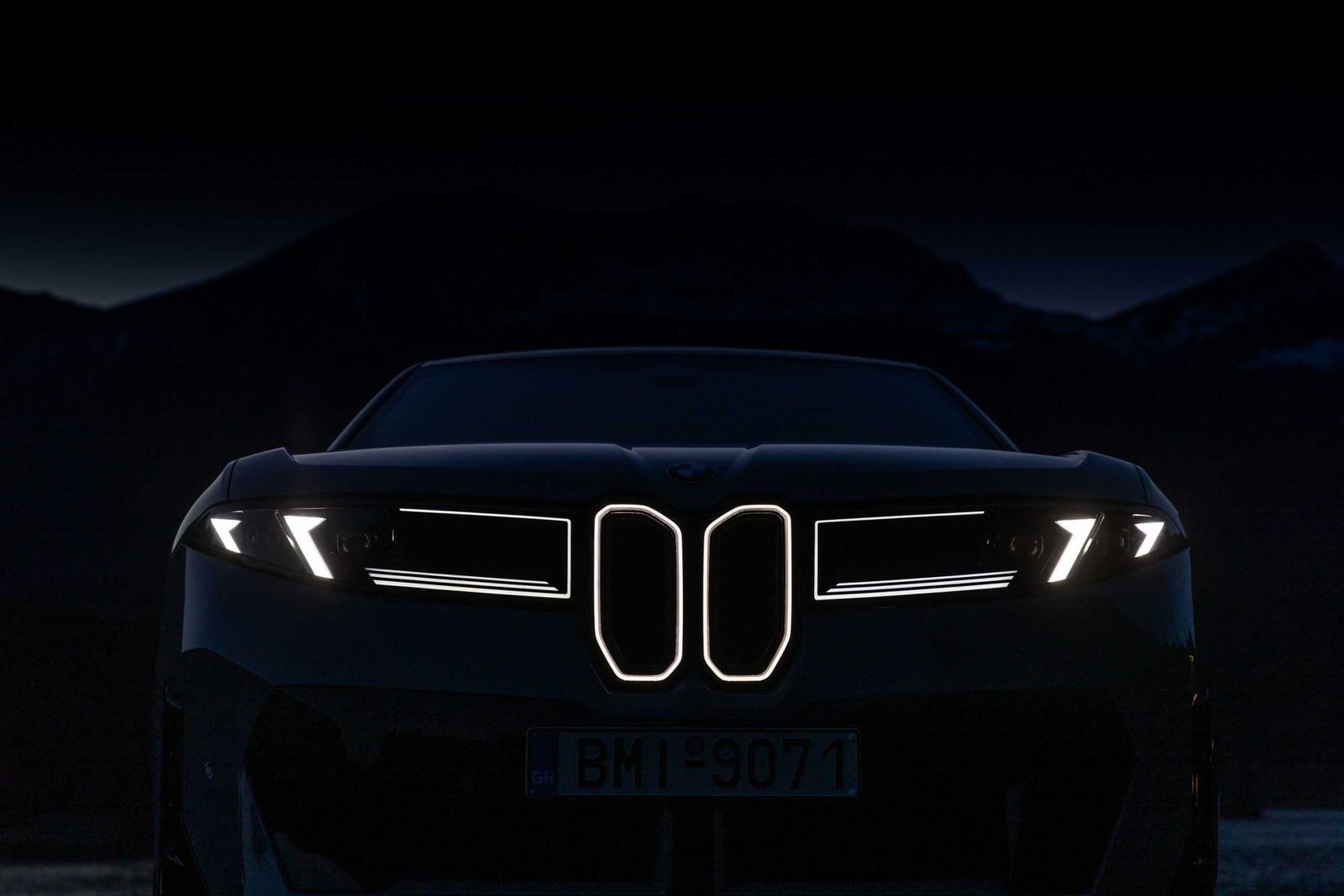
The kidney grille is obviously where your eye goes first, so let’s deal with it. Gone is the wide, chrome-framed, argument-starting grille of recent BMWs. What’s taken its place on the iX3 is a smaller, vertically oriented, three-dimensional shape — backlit, and designed to activate as you approach the car. BMW calls this the “phygital” approach: a mix of physical form and digital illumination that gives the front end a slightly animated, almost alive quality that photos don’t fully capture.
The vertical orientation is a deliberate callback to the 1960s Neue Klasse cars. Those kidneys were upright and compact, sitting naturally in the fascia rather than dominating it. The iX3 brings that proportion back in a modern form. It works.
Here’s something van Hooydonk admitted that’s worth noting: the oversized grilles of the past decade were partly driven by Chinese market preferences. That’s a rare public acknowledgment that the design had been shaped by one market at the expense of BMW’s broader identity. The Neue Klasse is explicitly intended to have global appeal again.

For sedans — and this matters if you’re waiting for the i3 — the kidney takes a different shape altogether. Wider, lower, more horizontal, with light graphics running through it. It’s closer to what you’d expect from a classic BMW saloon, which makes sense given the i3 is meant to be the spiritual successor to the 3 Series.
The headlights are the other major story. The classic four-eye face is still there, but completely rethought. Round units are out. In their place are slanted, vertical LED elements — sharper and more architectural — that keep the twin-light signature recognizable while making it feel genuinely new rather than warmed over.
As the design spreads to larger models, those signatures will keep evolving too. Renderings for the 2027 X5 point to an X-shaped DRL pattern inside the headlights — a reference to xDrive. Still unconfirmed, but honestly, it would fit perfectly.
The Front, Sides and Rear: Less Is Doing a Lot of Work Here

Walk around the iX3 and the thing that hits you isn’t what’s there — it’s what isn’t. Recent BMWs piled on character lines. Hood folds, shoulder creases, door swells, all stacked on top of each other. The Neue Klasse cars remove most of it. Big, clean surfaces defined by just a few precise lines. The body looks sculpted rather than over-worked.

The nose has a subtle downward slope toward the front fascia that long-time BMW fans will recognize immediately — it’s the old shark-nose quality from E30-era cars, brought back quietly and without fanfare. Air openings are smaller too, and that’s not just a styling choice. On an EV platform, you genuinely don’t need massive inlets, so the design doesn’t have to fake them.
The Hofmeister kink is still there — BMW has used that rear quarter-window upturn since 1961 and it’s not going anywhere. But it’s sharper now, more deliberate. On recent cars it started to feel like a habit. Here it reads like a choice.

Out back, slim horizontal taillights stretch toward the center of the tailgate. Bumpers are cleaner without the faux diffusers and the overly aggressive lower trims that became visual noise on recent models. The rear of the iX3 has a composure that BMW SUVs have honestly been missing for a while.

The i3 sedan takes all of this even further. From what we’ve seen in spy shots and renderings, it’s a proper 2.5-box sedan silhouette — long hood, short overhangs, a roofline that consciously echoes the E30 generation. Retractable door handles smooth out the flanks. It looks like a BMW that’s comfortable in its own skin, which hasn’t always been true of the brand’s recent designs.
The Interior: A Giant Tablet, But Better Than Before

Here’s where the “digital” part of BMW’s philosophy actually shows up, and it’s more interesting for what BMW chose not to do.
The centerpiece of the Neue Klasse cabin is Panoramic iDrive — a fancy sort of head-up display that spans the full width of the windscreen, paired with a 17.9-inch central touchscreen for secondary functions. The driver’s portion of the Panoramic Display stays clean and relevant: speed, navigation, charge level. The wider portion of the display opens up the experience for everyone in the car. The steering wheel loses its physical buttons in favor of many haptic control pads with tactile feedback.

But here’s what actually matters: BMW didn’t just turn the dashboard into a screen. No single giant tablet eating the entire center console. No touchscreen-everything setup. Van Hooydonk drew a line early: “The car is not completely switchless.” Of course, many BMW enthusiasts would disagree and that’s fair if you compare the iX3 to many of the previous BMWs.
The overall dashboard architecture is cleaner, more horizontal, more open. But at the same time, it doesn’t feel like a cockpit anymore. Surprising? Hardly. The writing has been on the wall for quite some time. The 1960s Neue Klasse interiors used simple analog gauges because that was the best technology available then. The new one uses screens and haptics for the same reason because that’s what some of the new generation drivers want now.
So where does this actually leave us?

The old BMW design era had its defenders, but by the early 2020s the grille jokes had taken on a life of their own. The kidney became the thing people talked about instead of the cars. Van Hooydonk clearly knew it: “The overall design language is going to be cleaner than what you know from us today, but it is 100 percent recognizable as a BMW.”
Looking at the iX3, and at what we’ve seen of the i3 in teasers, that claim holds up. The brand DNA is intact — the kidneys, the shark nose, the Hofmeister kink — but it’s all speaking a quieter, more confident language now.
Is it universally loved? No. It won’t be. The front end, particularly on the iX3, still divides people — Carwow were blunt that it isn’t conventionally pretty, even while acknowledging it has real presence. And that’s fine. BMW design has rarely been universally loved at launch. The E65 7 Series was genuinely controversial. The E60 5 Series got brutal reviews. History has been kind to both.
What’s different this time is coherence. The iX3 and the early i3 spy images clearly speak the same language in a way that, if we’re honest, recent BMW sedans and SUVs sometimes didn’t. They felt like they came from different design teams working in parallel. The Neue Klasse cars feel like they belong together.
That’s not a small thing. The i3 debuts this month. The X5 generation isn’t far behind. We’re about to find out just how far BMW can take this.

