


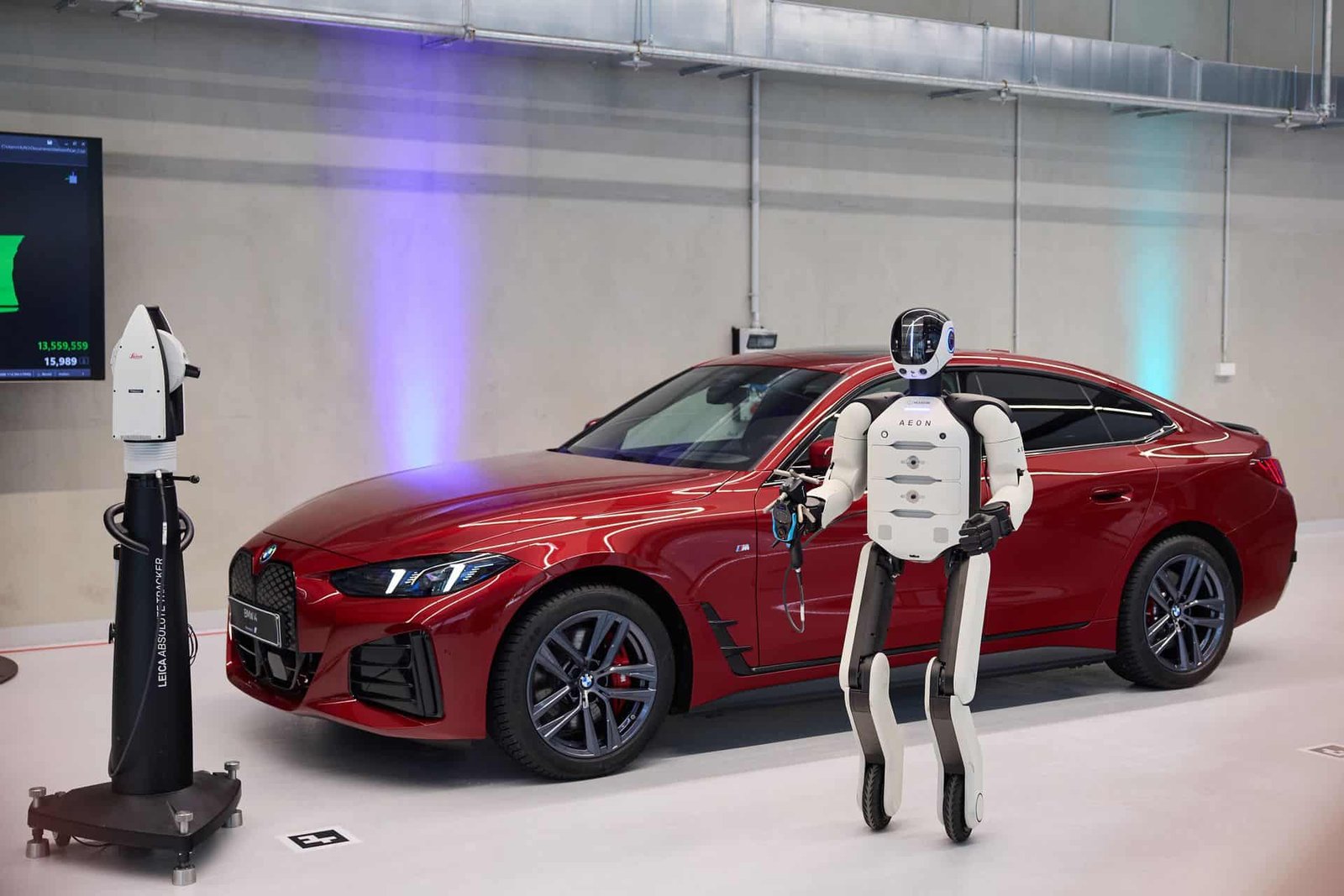
BMW is placing humanoid robots on the factory line at its Leipzig plant — the first time the company has deployed them at a European facility — as the auto industry turns to AI-powered robotics to reduce labor costs and tackle physically demanding tasks. A small number of the machines, supplied by Hexagon Roboticswill go to work on assembly lines and in the production of high-voltage batteries for electric vehicles, an area where employees currently have to wear cumbersome protective clothing.
What Is Physical AI, and Why Does It Matter?
BMW calls this “Physical AI” — intelligent systems that can perceive, reason, and act within complex, real-world manufacturing environments. It’s a significant evolution beyond traditional automation, and it’s built on a foundation the company has been quietly constructing for years: a unified data infrastructure across its entire production network that lets AI agents take on increasingly autonomous tasks and keep learning over time.
“Digitalisation improves the competitiveness of our production — here in Europe and worldwide,” said Milan Nedeljković, BMW’s production chief, who is set to become the company’s CEO in May. “The symbiosis of engineering expertise and artificial intelligence opens up entirely new possibilities in production.”
Leipzig Gets Its First Humanoid Robot

Hexagon’s humanoid, AEON — unveiled in June 2025 — features a human-like body that can accommodate a range of hand, gripper, and scanning attachments, and moves dynamically on wheels. The Leipzig pilot began in December 2025. A broader test deployment is planned for April 2026, with a full-scale pilot launching in summer 2026. The robot’s focus will be on high-voltage battery assembly and component manufacturing — two areas where precision, safety, and ergonomics are all critical.
Humanoid robotics is explicitly positioned as a complement to existing automation, not a replacement for workers. BMW says the goal is to “relieve employees and further improve working conditions” — particularly in repetitive or physically taxing roles. But there’s a business case beyond labor conditions, too. According to Michael Ströbel, BMW’s head of process management, humanoids could eventually allow BMW to bring work in-house that currently goes to suppliers. “This gives us opportunity to do more production in-house,” he said.
Lessons Learned from Spartanburg

BMW didn’t start this experiment in Europe. The world’s first deployment of a humanoid robot at a BMW plant took place in Spartanburg, South Carolina, in 2025 — in partnership with California-based Figure AI. The results were striking.
Over ten months, Figure AI’s Figure 02 robot worked daily ten-hour shifts Monday through Friday, supporting the production of more than 30,000 BMW X3s. The robot handled the precise removal and positioning of sheet metal parts for welding — a repetitive, physically demanding task that was, in BMW’s own words, “particularly demanding in terms of speed and accuracy while also being physically exhausting.” By the end of the program, it had moved over 90,000 components, logged roughly 1,250 operating hours, and covered approximately 1.2 million steps.

The Leipzig pilot is similar in scale, and BMW is applying the Spartanburg lessons directly. One of the key takeaways from the US trial: the transition from lab to production floor happened faster than expected. Motion sequences trained in controlled settings transferred smoothly into stable shift operation, and the robots were integrated with BMW’s Smart Robotics ecosystem via standardized interfaces.
A New Center of Competence

To structure and scale this work, BMW has established a “Center of Competence for Physical AI in Production.” The center consolidates expertise from across the organization and gives technology partners a defined evaluation path — from lab testing using real BMW production use cases, to initial plant trials, to full pilot phases.
“Our aim is to be a technology leader and to integrate new technologies into production at an early stage,” said Michael Nikolaides, Senior Vice President Production Network, Supply Chain Management at BMW Group. “Pilot projects help us test and further develop the use of Physical AI — AI-enabled robots capable of learning — under real-world industrial conditions.”
BMW’s move reflects a broader shift across the auto industry, which has increasingly looked to humanoid robots both as a way to upgrade factories and as a potential new product market.
BMWBLOG will have its own on-site reporters and video coverage from Plant Leipzig in the coming days. Stay tuned for an up-close look at AEON in action and exclusive insights straight from the production floor. Here is an Instagram video to see it in action:

