
Article Summary
- BMW has used additive manufacturing across all brands and every production plant worldwide for over three decades, making it one of the most embedded adopters of the technology in the industry.
- The shift from weeks to hours on crash test component turnaround is one of the most tangible benefits — cutting development time and cost significantly for new vehicles.
- Wire Arc Additive Manufacturing, borrowed from aerospace, will allow BMW to print large single-piece metal structures at scale, with series production components arriving from 2027.
When a part fails a crash test inside a BMW factory, someone used to deliver bad news: new tooling, new lead times, start again from scratch. Weeks gone. Now, an engineer rethinks the specs and a few hours later, a new component rolls off a printer, ready to test again. That shift — from weeks to hours — is what 35 years of betting on additive manufacturing actually looks like.
BMW’s Quiet 35-Year Experiment
BMW started 3D printing parts in 1990. Not to experiment, not to prototype trinkets — to solve real production problems. That early commitment has compounded into something few people outside the industry fully appreciate. Today, printed components are built into series production vehicles wearing every badge the group makes: MINI, BMW, Rolls-Royce, and BMW Motorrad. Not in one factory. In every plant the company runs worldwide.
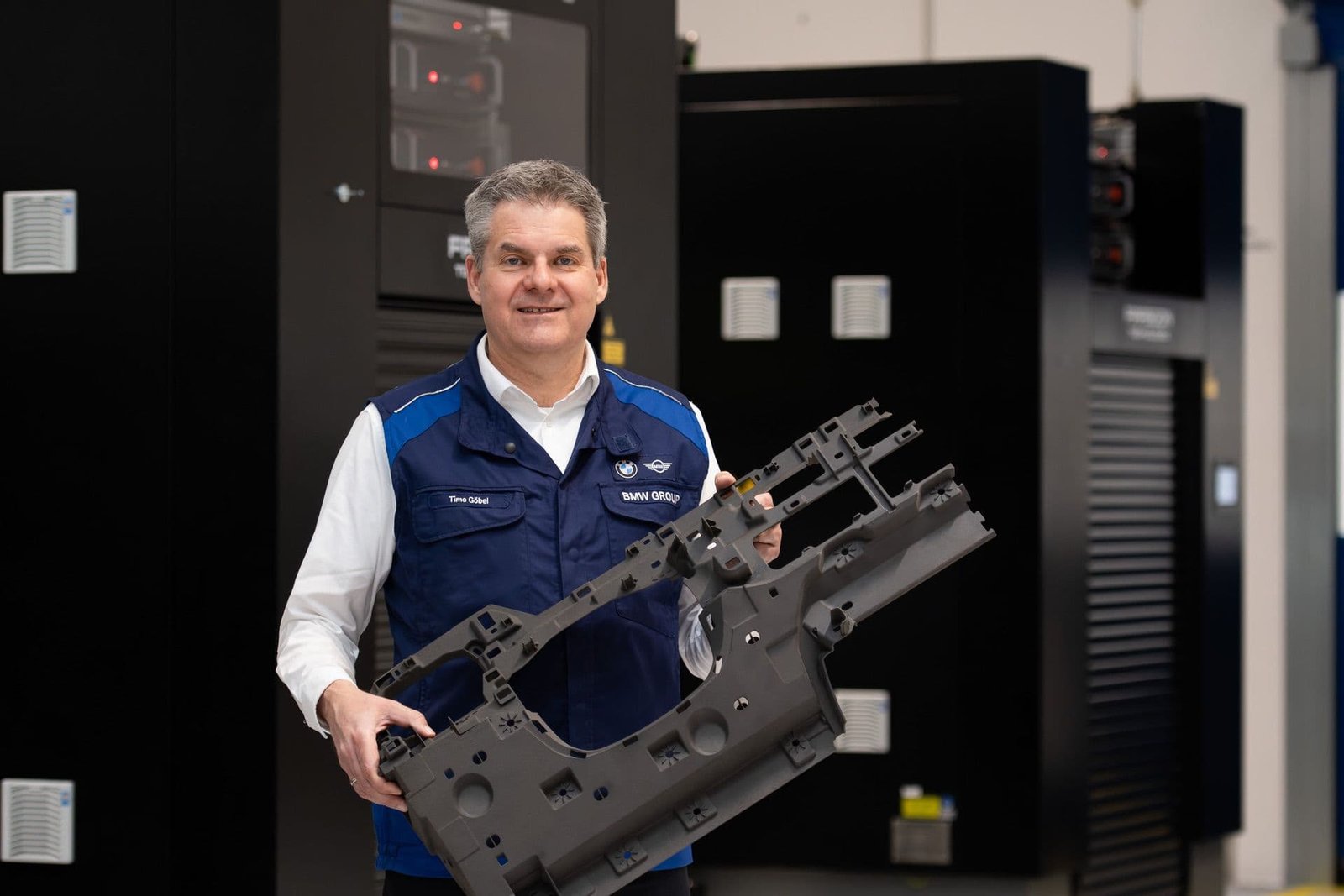
Timo Göbel, BMW Group’s head of additive manufacturing, describes the current state plainly: the technology is now woven into “all phases of the product life cycle,” from the first prototype sketch through to aftersales spare parts for customers. That last point matters more than it might seem — printed-on-demand parts eliminate the need to warehouse vast inventories globally, and mean a customer waiting on an obscure component no longer has to wait weeks for it to be manufactured.
Faster Development, Better Testing

The development benefits are equally tangible. When BMW’s engineers need to test a new component geometry — or when something fails a crash test — the old path required commissioning new tooling, waiting for it to arrive, and starting the testing cycle over. That process could burn weeks and significant budget. With additive manufacturing, a failed component can be redesigned, produced, and ready for retesting within hours. BMW’s new class of electric vehicles and the latest generation of its electric drive technology both benefited from this compressed timeline during development.
What Comes Next: WAAM
The most significant leap on the horizon is Wire Arc Additive Manufacturing — a technology borrowed from aerospace, oil and gas, and maritime industries — which uses an electric arc to deposit metal at speeds and scales that earlier printing methods couldn’t approach. Where current metal printers work with fine powder in sealed chambers, WAAM builds large, single-piece structural components that would previously have required complex assembly from multiple parts.
BMW has been developing the process at its Additive Manufacturing Campus since 2024. Vehicle testing using WAAM-produced components began in 2025, with series production set to follow in 2027.
The implication is significant: BMW will soon be printing large structural parts with shorter lead times and without the tooling that conventional manufacturing demands. The factory becomes faster, more flexible, and less dependent on supply chains that can — as the industry learned painfully in recent years — break without warning. Layer by layer, this is what the next generation of car manufacturing looks like.
