
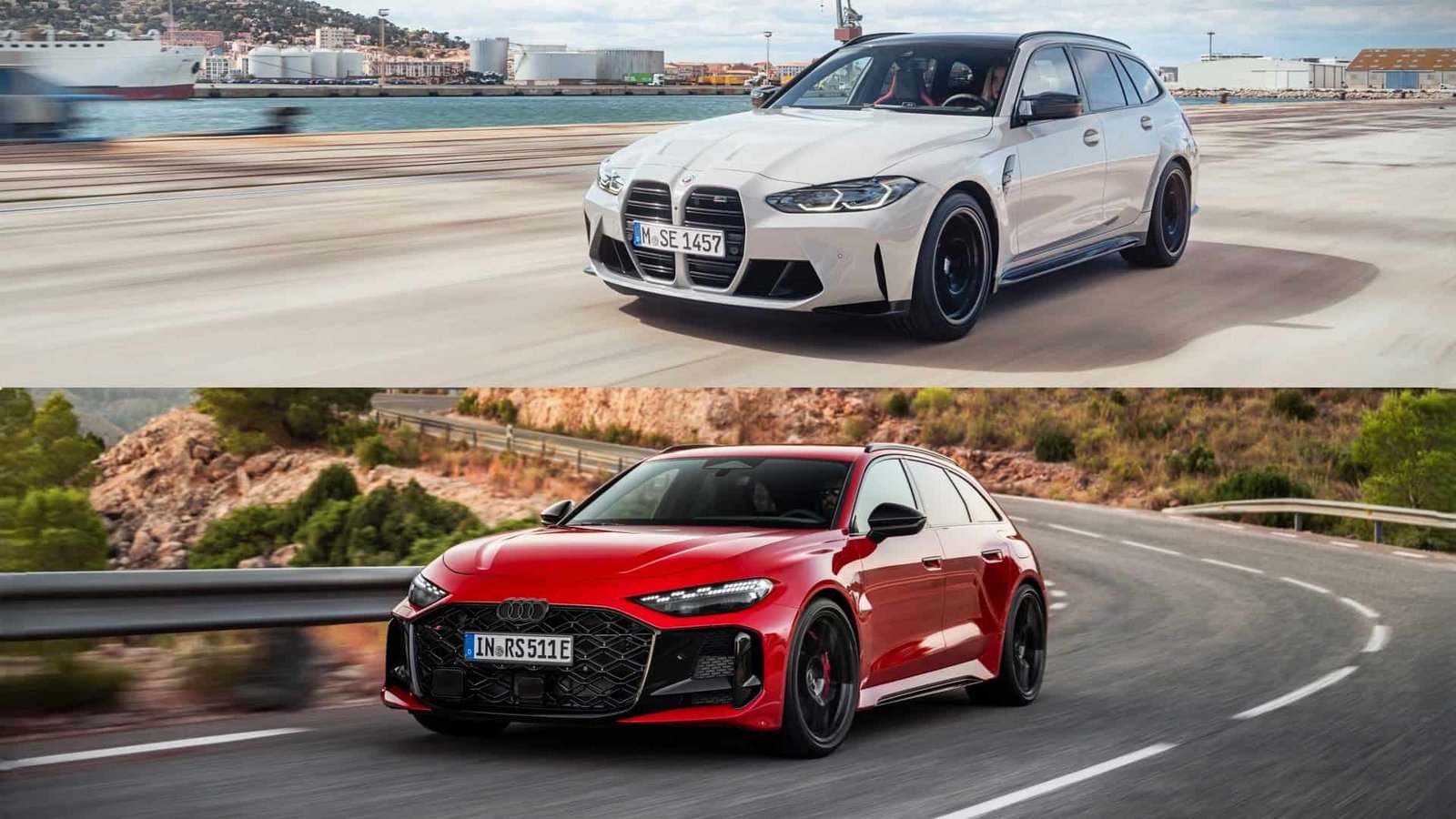
Audi’s high-performance wagons are sticking around for at least one more generation, it seems. The brand’s RS 5 Avant debuted alongside its sedan counterpart today, and naturally, we think it’s only fitting to pit the two against one of our favorite modern BMWs: the BMW M3. The two models prioritize performance and practicality, but both go about it in different ways. In fact, despite the RS 5’s price tag — which almost directly mirrors the M3’s — the car has a lot in common with the M3 big brother, the M5. Namely, a hybrid powertrain. But we’ll get there in just a second. First, let’s look at the very different designs of the Audi RS 5 and BMW M3.
Exterior Design

The Audi RS 5 and M3 both feature…shall we say, prominent front grilles. In fact, most of the lower half of the RS 5’s fascia is just grille. “Conservative” isn’t a trait I’d immediately ascribe to the G80, but the RS 5 makes a good case for it. Larger intakes under the headlights also contribute to the racier look. The theme continues along the side of the RS 5. Aggressively bulging front and rear bumpers give the RS 5 an arguably even more roided-up look than the Bimmer. The RS 5 also comes with slightly bigger wheels — 21-inchers versus the staggered 19/20-inch setup on the M3.
Around back, the RS 5 dons a lightbar running the horizontal length of the trunk. The stretched tail lights really emphasize the car’s bubbly rear fenders. Massive dual exhaust outlets, typical Audi RS ovals, appear much larger overall than the M3’s signature quad tailpipes. Both cars are short of conventional beauty. But the RS 5, to my eye, looks way more aggressive.
Interior Design

There’s less to talk about when moving inside the cars. Though both the M3 and Audi RS 5 approach interior design a little bit differently, the headline remains the same no matter which cabin you’re looking at: screens everywhere. No word yet on whether or not Audi will offer something comparable to M’s bucket seats. The presence of a passenger-side screen in the RS 5 and the existence of an iDrive controller in the BMW are two more identifying features, although who knows how much longer the iDrive knob will be there. Audi appears to have switched almost entirely to haptic touch buttons on the door, too. Not a welcome addition to my eyes, but hey, that’s car design today.

As far as actual functionality goes, the RS 5 has some tricks up its sleeve. Audi offers massaging seats, which aren’t available on the M3 (but are on the M5). The base interior is touted as “leather-free,” which is likewise something BMW doesn’t give you. A 20-speaker Bang & Olufsen sound system comes with the Audi — the BMW sticks with Harman Kardon. An optional Audi Sport Package further decorates the interior to the tune of brass-colored accents and green contrast stitching and some additional badging on the steering wheel and floor mats. I prefer the BMW layout; but then, this is BMWBLOG. That said, Audi certainly has done a good job of making the RS 5 feel special.
Performance

Here’s where things get muddled between the M3/RS 5 comparison. Whereas the current M3 relies solely on a twin-turbo inline-six, the RS 5 now relies on a hybrid powertrain like the G90 M5. The RS 5 similarly gains a ton of weight, and indeed the RS 5 Avant tips the scales at around 230 pounds less than the M5 Touring. Even the sedan weighs 2,355 kg (5,191 pounds); the M3 by comparison is a lightweight at nearly 1,000 pounds less. The added weight comes with a substantial power bump; the RS 5’s twin-turbo 2.9-liter V6 and electric motor are rated for 630 horsepower and 825 Nm/608 pound-feet.

As my colleague Adrian already pointed out in his news piece about the new Audi RS 5the M3 remains the “purist’s choice.” An optional manual transmission, a significantly smaller curb weight and footprint, and a less complicated powertrain (available RWD, no hybrid power) make it the best choice for those only concerned with dynamics. That said, the fact that the larger and heavier Audi will still race from zero to 60 mph in an estimated 3.6 seconds — and manage around 50 miles of electric-only range — make it certainly no less impressive, albeit in a different class of comparison.
Technology

The biggest technology gap between the RS 5 and M3 is arguably the Audi’s hybrid powertrain. Otherwise, both offer similar levels of connectivity. Three displays, including the 10.9-inch passenger screen, mean the Audi’s cabin is just a tad bit heavier on the screens. Both cars get a head-up display, oodles of parking assistance features, and wireless Apple CarPlay/Android Auto. The iDrive controller still exists in the M3, which will make navigating screens easier if you’re accustomed to that sort of thing.
The new Audi RS 5 is certainly spicy. We eagerly look forward to seeing how it performs versus the M3 in the real world, where the weight/power changes can really twist outcomes in the quarter mile and track times. What do you think of the new RS 5? Has Audi jumped the shark in the design or is it just matching the M3’s energy?
